Eating Patterns
Seasonal Vegetables and Their Role in the Weekly Food Record
Harriet Whitfield · 12 February 2026 · 9 min read
An editorial record of five working days built around plant foods — observing how protein variety and fibre density contribute to sustained energy, active movement, and weight balance through a busy week.
Monday morning, Clerkenwell. A 45-minute run before the desk, followed by a breakfast built entirely from plant foods: whole oat porridge with a generous portion of flaxseed and walnut, topped with blueberries and a tablespoon of almond butter. The goal for the week is to record, as faithfully as possible, what an active working week looks like when built primarily around whole plant foods — and to observe, without intervention, how that structure relates to energy levels, activity, and the slow arithmetic of weight across five days.
The term "plant-based" has accumulated considerable noise around it in recent years — marketing claims, identity politics, and contradictory advice from every direction. What this piece is not interested in is any of that. It is interested in a simpler question: when someone who exercises regularly structures the majority of their daily food intake around plant foods — legumes, whole grains, vegetables, fruit, nuts, seeds, and plant-based fats — what does a working week actually look like, and how does weight behave across it?
The subject of this observation is not a committed vegan or a dietary ideologue. He eats fish and eggs on an occasional basis, and the plant-based framing refers to the structure of the weekly plate rather than a rigid exclusion of animal products. The question is one of proportion and priority: when plant foods constitute 80% or more of daily food volume across a working week, what patterns emerge in the relationship between nutrition, movement, and weight?
This is an important distinction to make clearly. Plant-based eating in this editorial context is a nutritional observation, not a moral position. The value being examined is nutritional: whether a plate structured primarily around plant whole foods provides adequate protein variety, sustained energy for daily activity, and a relationship with weight that is gradual and stable rather than erratic.

Fig. 01 — Morning run, Clerkenwell, 22 January 2026. Distance: 6.2 km. Duration: 38 minutes.
Monday follows the pattern already described: an early run, a substantial plant-based breakfast, a midday meal of red lentil soup with whole grain bread and a side salad of rocket, cherry tomatoes, and sunflower seeds, and a dinner of roasted sweet potato, black beans, sautéed spinach, and avocado. Total plant variety across the day: twelve distinct items. The journal notes a high energy level through the afternoon and a strong evening without fatigue.
Tuesday involves a longer desk period — seven hours with a single 20-minute walk at lunchtime. The meals follow a similar structure to Monday but slightly lighter at midday, with a quinoa and roasted vegetable bowl. The journal notes a mild dip in energy at 15:30, which correlates with a smaller midday portion and no dedicated protein source in the afternoon. This is a useful data point: even within a plant-based structure, the absence of adequate protein at the midday meal registers in the afternoon energy record.
Wednesday includes a 50-minute cycling session after work, which alters the evening meal considerably: a larger portion of whole grain pasta with a tomato and lentil sauce, significant in protein and carbohydrate to support recovery from activity. Post-exercise, the body's requirement for both increases noticeably — the journal reflects this in the form of a larger appetite by 19:00 and a more substantial final meal. Weight on Wednesday morning shows no change from Monday morning, which is consistent with previous observations about mid-week stability.
"Even within a plant-based structure, the absence of adequate protein at the midday meal registers clearly in the afternoon energy record."
— Weekly food record, Tobias Ashcroft, January 2026
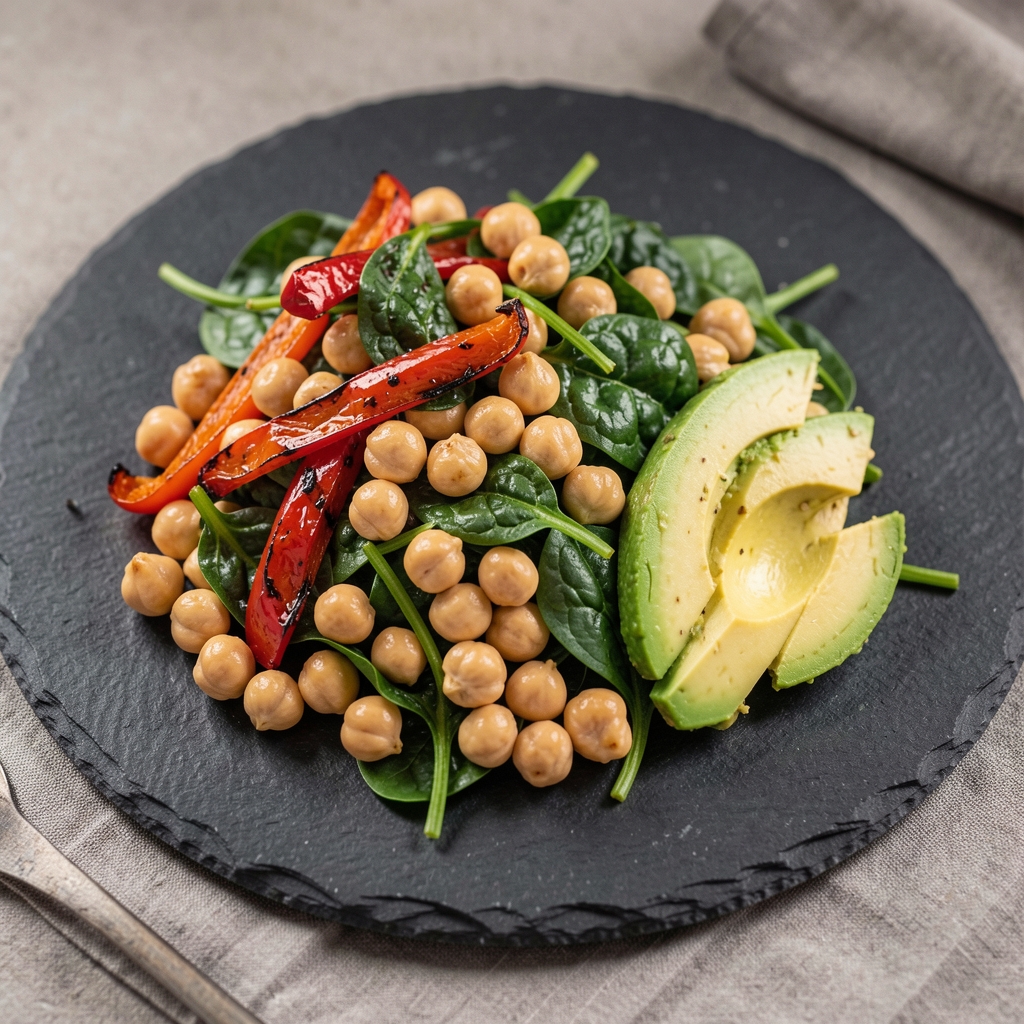
Thursday brings a more deliberate adjustment: aware of Tuesday's mid-afternoon dip, a larger and more protein-rich midday meal — a chickpea and roasted pepper stew with brown rice and a tahini dressing — is prepared. The afternoon passes without the energy dip observed on Tuesday. The journal notes this as a direct response to the previous day's observation: the food journal working as a real-time feedback loop rather than a retrospective record.
Friday is the most active day of the week: a morning yoga session, an active commute by bicycle, and an evening social event. The food choices are structurally consistent with the rest of the week but include a restaurant dinner — a vegetable-forward mezze with hummus, grilled courgette, stuffed vine leaves, tabbouleh, and warm flatbread. The absence of full ingredient knowledge is noted in the journal, as is the larger-than-usual portion size that a social setting naturally produces.
Friday morning's weight reading — taken at the same time and under the same conditions as Monday morning — shows a marginal reduction from the start of the week, consistent with an active lifestyle and a high-fibre, predominantly whole foods dietary structure. This is not a dramatic result, and it is not intended to be presented as one. It is a data point in a long-running record: a single working week, honestly documented.
Full plant-based structure, 12 distinct items, morning run. High sustained energy. Stable weight baseline.
Lighter midday portion, insufficient protein at lunch. Afternoon energy dip noted at 15:30. Walk at lunchtime only.
50-minute cycling session, post-exercise meal larger and carbohydrate-rich. No weight change from Monday.
Corrected midday protein (chickpea stew). Afternoon energy sustained. Journal feedback loop functioning.
Most active day. Restaurant dinner, unknown portions. Marginal weight reduction from Monday baseline on Friday morning.
One of the most consistent findings from this week — and from the broader editorial records maintained over the past year — is the degree to which movement and food choices interact in determining weekly weight patterns. An active week with a poor food structure tends to produce more erratic weight readings than a less active week with a stable, high-fibre whole foods structure. Conversely, a well-structured plant-based diet without regular movement tends to produce stable rather than gradually shifting weight patterns.
The combination of regular low-intensity movement — daily walking, cycling, yoga, and occasional running — with a predominantly whole foods plant-based diet appears, across the editorial records reviewed, to be the combination most consistently associated with gradual, sustainable weight change over time. Not dramatic. Not fast. But steady and observable.
This is the kind of finding that does not generate headlines. There is no revelation here, no counter-intuitive twist. What the food journal makes visible is simply the ordinary relationship between activity, food quality, and weight — stripped of the noise that typically surrounds it in popular nutrition writing. That, for this publication, is more than enough.
The most common concern raised about plant-based eating in relation to an active lifestyle is protein adequacy — specifically, whether a predominantly plant-based diet can supply sufficient protein variety and quantity to support regular physical activity and maintain weight balance without muscle loss.
The short answer, based on both published nutritional research and this week's food record, is yes — with attention. The key word is variety. A plant-based diet that rotates through legumes (lentils, chickpeas, black beans, edamame), whole grains (quinoa, buckwheat, whole oats, brown rice), and nuts and seeds (hemp seeds, pumpkin seeds, almonds, tahini) provides a complete range of amino acids across the day without any requirement for precise combination at each meal. The historical advice to "combine proteins" at every meal has largely been updated by more recent nutritional research, which confirms that amino acid complementarity across the day is sufficient.
What Tuesday's energy dip illustrated was not a protein deficiency in the structural sense, but a tactical error in a single meal's composition — too light on protein for a midday meal on a day with significant afternoon desk work. The journal caught it. Thursday corrected it. This is precisely the cycle of observation and adjustment that makes food journalling, combined with an active whole foods approach, a genuinely useful long-term nutritional practice.

Tobias Ashcroft is a contributing writer to Drevanol Review. He writes on the intersection of active lifestyle, plant-based nutrition, and long-form food journalling from his base in London. His editorial approach is observational and personal — recording rather than prescribing.
More from Drevanol Review →Editorial Notice: Articles published on Drevanol Review are editorial in nature and reflect the writers' observations on everyday nutrition practices and weight awareness. The content is not intended as professional advice, nor as guidance for the management of any specific condition. Readers with specific concerns about their daily routines are encouraged to speak with a qualified wellness professional.